
 Journal
Energy Efficiency Certification in Spain: How EPC Ratings Are Reshaping Property Values
The European Energy Performance of Buildings Directive (EPBD), revised in 2024, will require all residential buildings to achieve a minimum energy rating of E by 2030 and D by 2033. For Spain — where over 80% of the residential stock predates 1980 and the average certificate is E or worse — the implications for property valuation are profound and immediate.
Energy certification has, until recently, been treated as bureaucratic formality in the Spanish real estate market. A document required for transaction, briefly inspected, and rarely a factor in negotiation. That era has ended. The revised European EPBD, approved in April 2024, establishes binding minimum energy performance standards that will reshape property values across the continent — and Spain, with one of Europe's oldest residential stocks, faces the steepest adjustment.
The Regulatory Framework The revised EPBD sets out clear timelines:
• By 2030, all residential buildings must achieve a minimum Energy Performance Certificate (EPC) rating of E. • By 2033, the minimum rises to D. • Member states must transpose the directive into national law by mid-2026.
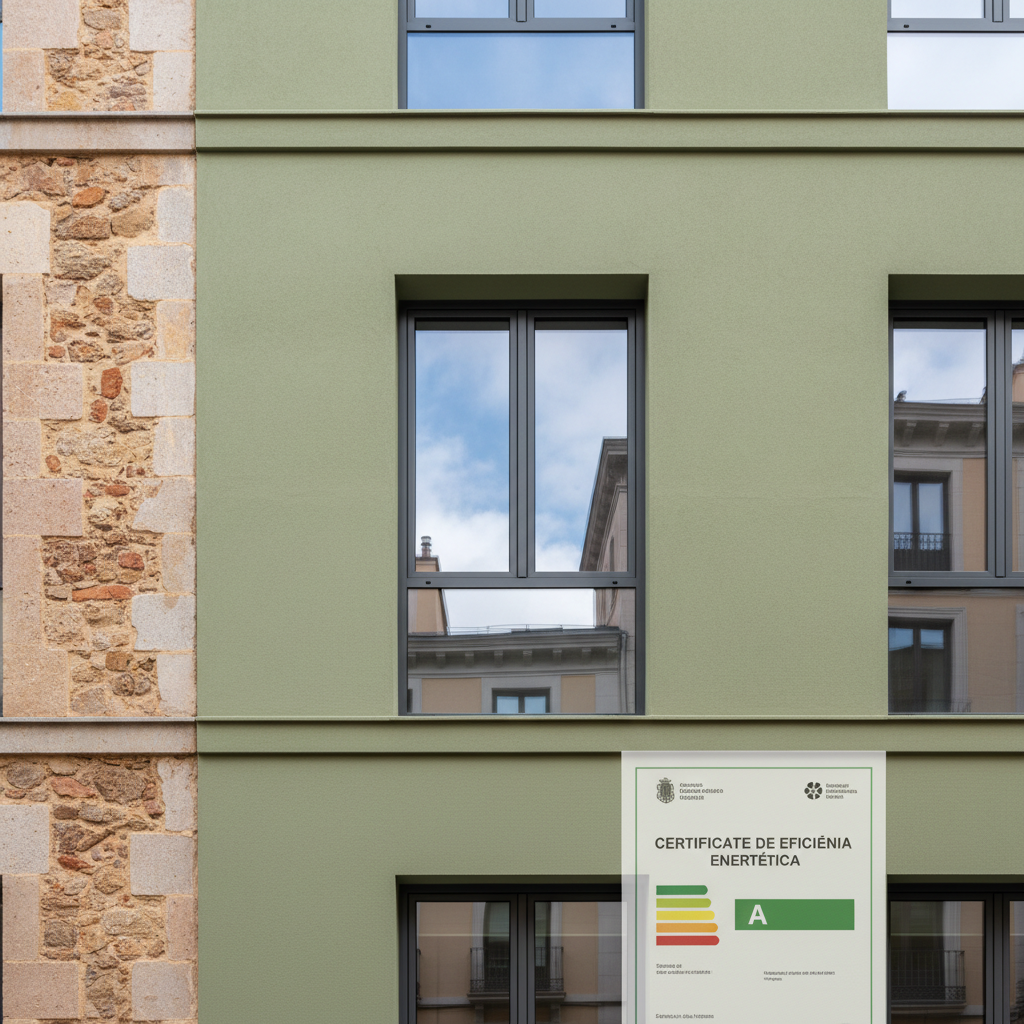
In Spain, EPC ratings are issued under Royal Decree 390/2021 and are graded from A (most efficient) to G (least efficient). The certificate is valid for ten years and must be presented at the point of sale or rental.
The Spanish Reality According to data from the IDAE (Institute for Energy Diversification and Saving) and the Ministry for Ecological Transition, the distribution of EPC ratings in Spain's residential stock is heavily skewed toward the lower end:
• Approximately 80% of certificates issued fall in the E, F or G range. • Only around 5% of the residential stock achieves a B or A rating. • The vast majority of pre-1980 buildings — which represent the bulk of urban Madrid, Barcelona, and the historic centers — sit at E or below by default.
This is the result of a residential stock built before energy efficiency standards existed. Single-glazed windows, uninsulated façades, and obsolete heating systems are the norm, not the exception.
The Valuation Impact The market is already pricing in the regulatory trajectory. Studies by the Banco de España and the European Mortgage Federation have begun to quantify what is known as the "green premium" and the "brown discount":
• In several European markets, A-rated assets command a premium of 5–12% over comparable D-rated assets. • Conversely, F and G rated assets are beginning to trade at measurable discounts, particularly in jurisdictions where the rental of low-efficiency assets has been or will be restricted.
In Spain, this effect is still in its early stages — but it is accelerating. Institutional buyers, in particular, have begun to apply energy ratings as a screening criterion. An asset rated F or G in a portfolio acquisition is increasingly treated as a deferred capex obligation, with the cost of rehabilitation discounted from the offer price.
What Buyers and Sellers Should Understand For sellers of older urban properties — particularly in central Madrid — the strategic question is whether to certify and sell, or to invest in rehabilitation prior to listing. The economics depend on three variables:
- The current rating versus the achievable post-rehabilitation rating.
- The cost of intervention (window replacement, façade insulation, heating system upgrade).
- The timeline. With the 2030 E-rating threshold approaching, the window for selling without discounting is narrowing.
For buyers, the opportunity is twofold. First, well-rehabilitated assets in central districts will command increasing premiums as the regulatory deadlines approach. Second, F and G rated properties in prime locations may offer entry opportunities — provided the buyer has the appetite and capital for a full energy retrofit, and understands the European subsidies (Next Generation EU funds, IDAE programs) that partially offset rehabilitation costs.
The Strategic Reading Energy efficiency is no longer a footnote in the property dossier. It is a primary valuation driver, and its weight will only grow between now and 2033. For the prime Madrid market, where buildings dating from 1880 to 1970 dominate the stock, this represents both a risk and a structural opportunity.
The assets that will hold and grow value over the next decade are those that combine three attributes: location in a protected urban fabric, architectural patrimony, and a credible path to compliance with the new energy standards. Two out of three will no longer suffice.

Helena Gallego Crespo
Helena Gallego Crespo is a prime real estate advisor specialising in luxury property and investment across Madrid's most exclusive districts — Salamanca, Chamartín, El Viso, Retiro, Jerónimos, Chamberí, Pozuelo de Alarcón and La Moraleja. Combining technology, data analysis and a curated off-market portfolio, she advises owners, developers and international investors on maximising asset value.